
Agribusiness · Business Strategy
El Niño and agricultural markets
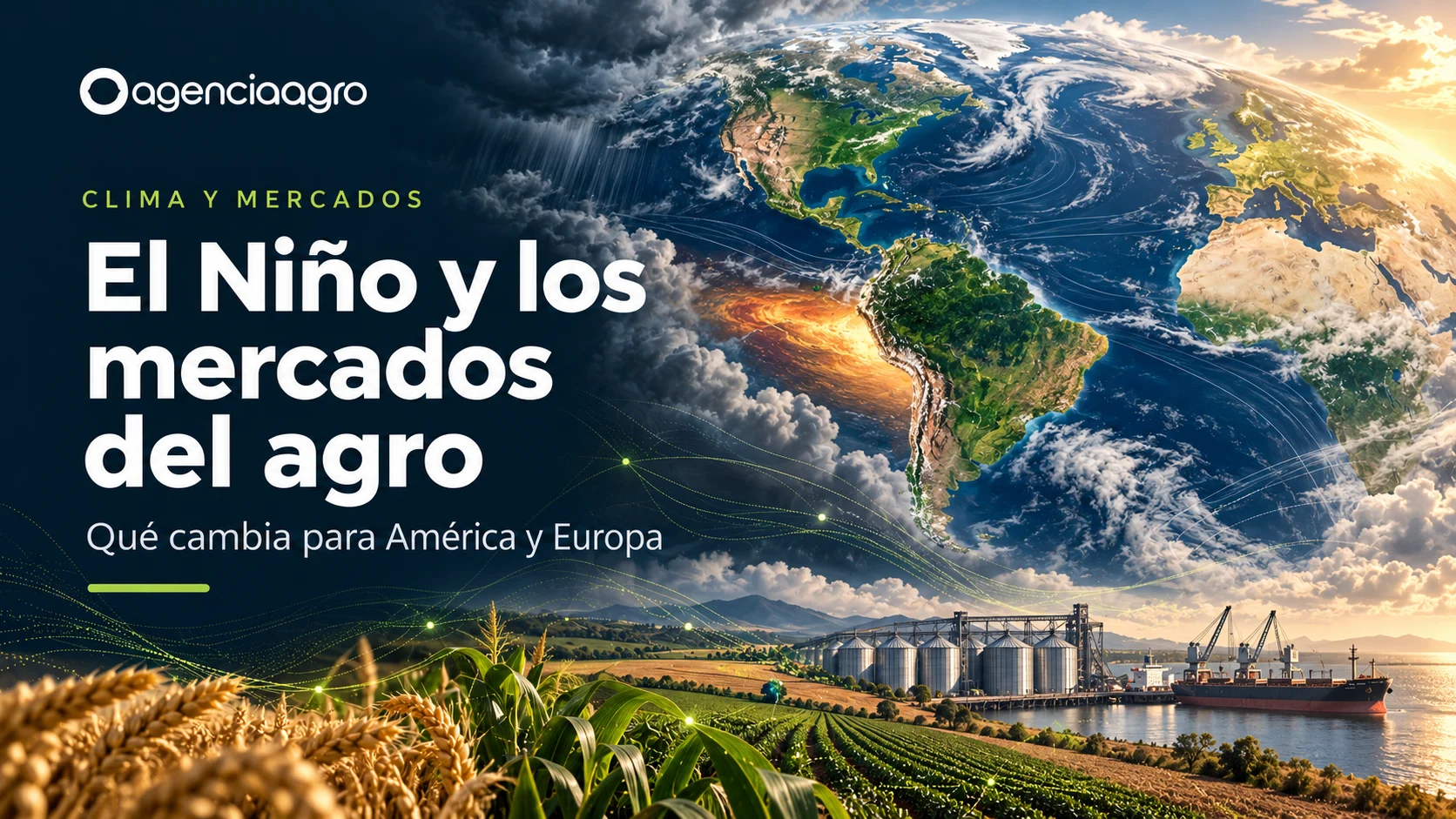
What is changing for the Americas and Europe
An agribusiness company may operate far from the Pacific and still feel the effects of El Niño: a supplier delaying a delivery, a customer reconsidering a purchase, or a cost changing expected profitability. For CEOs and sales teams, the challenge is to understand where the business is exposed and which decisions should be reviewed before committing to volumes, prices, or deadlines.
Headlines refer to a “super El Niño.” The expression attracts attention, but strategy requires greater precision: distinguishing the observed phenomenon, the forecast for the coming months, and changes already visible in markets. Nor is there a single outcome for agriculture as a whole. The same conditions can favor one crop and harm another, depending on the region and the production stage.
What we know about the current episode
On October 8, NOAA reported that El Niño was continuing to strengthen and considered it likely to remain strong to very strong through January–March 2027. In its October 21 update, WMO maintained the intensification scenario, with a peak expected around December. [1][2]
These are climate outlooks, not a final assessment of harvests. Decisions about planting, shipping, or purchasing require comparing them with local weather information, crop conditions, and operational capacity. The intensity of the phenomenon alone cannot determine how much a company will lose or gain.
What has changed in global markets
In September 2026, FAO recorded a 1.5% monthly increase in its Food Price Index. Cereals rose 5.1% and sugar 6.1%. It also noted that logistics restrictions in the Black Sea prompted wheat importers to seek alternative origins. These are observed movements, not guaranteed future increases. [3]
For sugar, FAO linked supply pressure to weaker prospects in Thailand and India, rain in Brazil, and a smaller sugar beet area in the European Union. Its analysis also identifies rice in South and Southeast Asia as an area of uncertainty associated with El Niño. [4]
Our business perspective is that climate risk should be considered separately from transportation constraints, energy, and commercial conditions. They may occur simultaneously but require different responses. A higher international price does not guarantee a better margin either: what matters is how much can be sold, at what quality and cost, and by what date.
The Americas need a region-by-region assessment
For October–December, WMO anticipated a greater probability of above-normal rainfall in southeastern South America and drier conditions in southern Central America, parts of the Caribbean, and northwestern South America. These regional signals must be checked against national and local services. [5]
From a management perspective, this calls for reviewing two different scenarios. Where water is scarce, water availability, animal feed, and production continuity should be assessed. Where there may be excess water, drainage, crop health, field access, and harvest windows become important. These are potential priorities, not assessments of losses that have already occurred.
In the United States, NOAA’s October 15 forecast for December–February favors a warmer north and a wetter south and East Coast. Rain could ease drought conditions while also increasing flood risks. [6] For operations in Mexico, Canada, or individual U.S. states, a continental signal should not be extrapolated: each business’s location and calendar must be reviewed.
Europe combines production and commercial risks
In its autumn outlook, the European Commission projects corn imports of 25 million metric tons for 2026/27, amid lower domestic supplies following heat and drought. This is an import demand forecast; the report does not support attributing that production decline exclusively to El Niño. [7]
For an exporter in the Americas, this may be a signal to study buyers and destinations. Turning it into sales requires checking market access requirements, quality, availability, and logistics. For a European food or animal nutrition company, it suggests reviewing raw material exposure and alternative supply sources.
For climate, Copernicus favors above-average seasonal temperatures and precipitation across much of Europe, with weaker signals in some areas. [8] This is not a uniform forecast for every country, nor does it allow every European weather event to be attributed to the phenomenon.
What an agribusiness company should review
A useful review starts by identifying the markets, suppliers, and products where exposure is concentrated. Specific monitoring signals should then be assigned: raw material availability, delivery date changes, customers’ technical needs, and transportation restrictions. Each signal needs an owner and an associated decision.
There is also positioning work to do. A company offering irrigation, genetics, nutrition, animal or plant health, or technology should explain the specific need it can address, the evidence supporting it, and the conditions required. Generic promises of “resilience” add little when buyers need to know how to implement a solution and what support they will receive.
At AgenciaAgro, we help connect market analysis, value propositions, and sales communication for agribusiness companies operating internationally. If this context is changing your customers’ priorities, let’s discuss how to adapt your strategy and sales tools.
Let’s discuss your company’s next challenges
Sources
[1] NOAA CPC · ENSO Diagnostic Discussion · 8 October 2026
[2] WMO · Global Seasonal Climate Update NDJ 2026–27 · 21 October 2026
[3] FAO · Food Price Index September 2026 · 2 October 2026
[4] FAO · Food prices, weather and transport disruptions · 2 October 2026
[5] WMO · Sea-surface temperatures reflect strengthening El Niño · 8 October 2026
[6] NOAA · U.S. Winter Outlook · 15 October 2026
[7] European Commission · EU agricultural markets short-term outlook · Autumn 2026