
Agribusiness · Business Strategy
Global innovation, local growth: how to grow in Latin American agribusiness
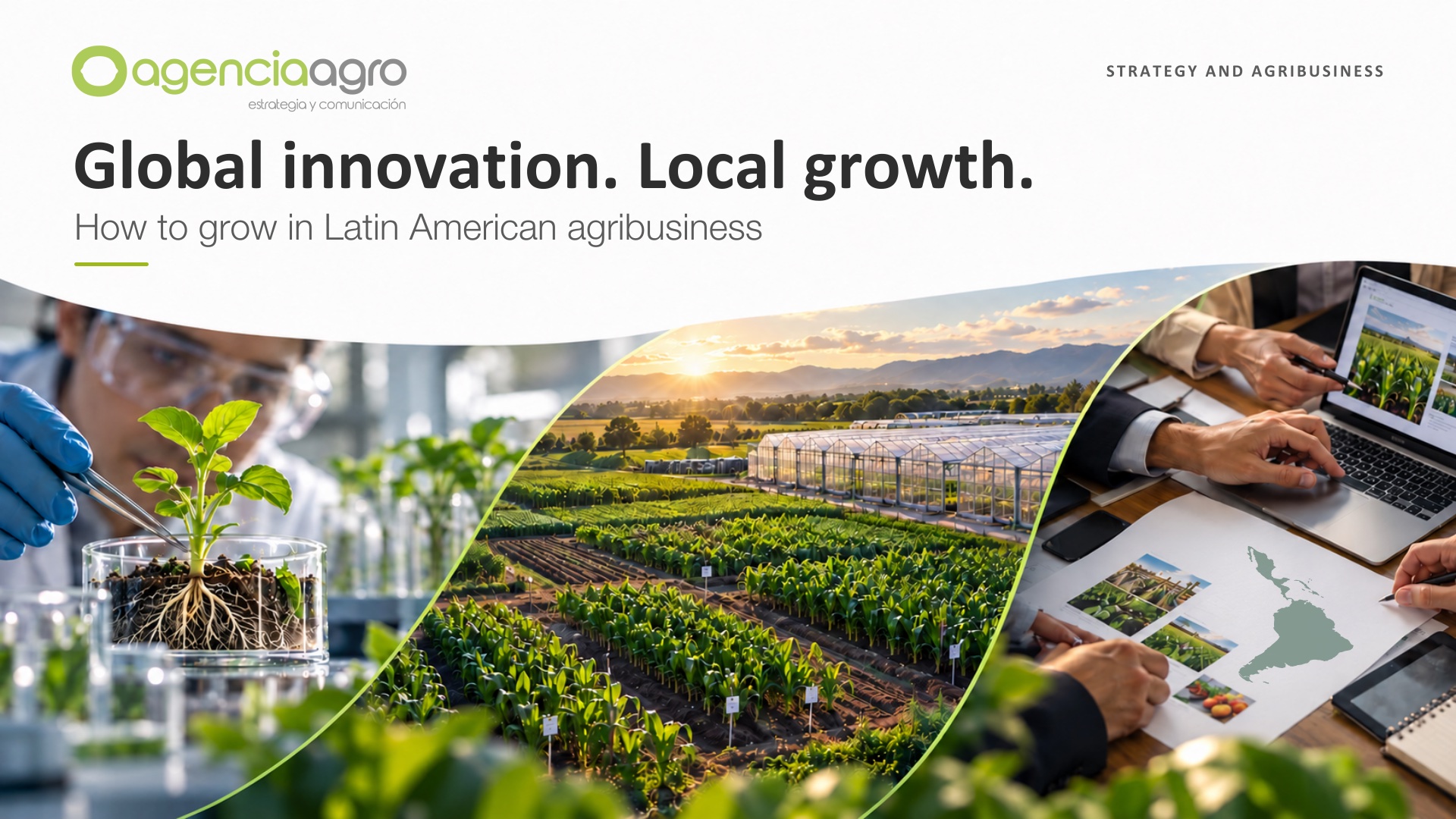
What major companies’ moves reveal, and how to build a commercial strategy that matters in each market.
A company can have strong research, technology and a competitive portfolio, yet still face a difficult question when planning its expansion: why should a customer who does not know us choose our business?
For regional leaders, the challenge emerges when a global proposition must become a concrete sales conversation. Distributors need clear arguments. Technical teams must substantiate claims. Buyers want to understand what will change in their operations. The brand needs to communicate all of this consistently.
Recent announcements from international companies provide a starting point for examining how to build that connection in Latin America.
Innovation in a market that demands differentiation
In its results for the first nine months of 2026, released on October 30, Syngenta reported price pressure on off-patent products in Brazil and Latin America, alongside growth in newly introduced technologies and higher-margin products.
On September 2, Bayer outlined progress in its global launch programme: Preceon was already present in Mexico, with its commercial introduction in Argentina planned for 2026. Intacta 5+ was expected in Brazil in 2027/28, subject to factors including regulatory approval.
BASF, meanwhile, reported lower volumes and a slight price decline in Agricultural Solutions for the third quarter on October 28.
These are different business situations. Our interpretation is that innovation, value proposition and access to customers should be assessed together. These reports do not establish that communication campaigns caused commercial performance; they provide context for positioning decisions.
Brazil and Mexico: define the market you intend to win
“Growing in Latin America” needs a more precise definition. For a company prioritising Brazil or Mexico, the first decision should identify the crop or value chain, region, customer profile and distribution model.
In Brazil, it is useful to validate how selling arguments change across production regions and what role cooperatives, distributors, advisers and direct sales will play. In Mexico, the same variables deserve attention: an export-oriented vegetable operation, for example, may need a different proposition from a grain producer. These are diagnostic questions, not uniform descriptions of either country.
The same discipline can guide expansion into Argentina, Colombia, Chile or Peru. Each market requires its own objectives and resources: where the opportunity lies, what prevents the company from capturing it and who will be accountable for developing it.
Turn technology into a business decision
A technical feature becomes commercially relevant when a customer understands its application, supporting evidence and limitations.
Consider a biological inputs company preparing a launch. Its communication should explain the problem the product addresses, the conditions under which it was evaluated, the support available and how it fits into existing crop management. Yield or profitability claims need applicable evidence; trial results require context.
The same principle can guide communication for seeds, machinery, nutrition and animal health. The required evidence, authorisations and people influencing the purchase vary across industries. The value proposition must hold up in both technical and commercial discussions.
Prepare the channel before expanding promotion
A campaign can generate interest. To turn that interest into progress, the next step needs to be ready.
Distributors need a concise presentation, arguments for each segment, responses to objections and clarity on availability and support. Sales teams need to know which campaign generated an enquiry, what the contact is seeking and what action should follow. The website should make verified information and a qualified contact easy to find.
A regional launch meeting can help agree on these materials and responsibilities. Communication assets then become part of the sales process, with a clear purpose at each stage.
A global brand with local decisions
International consistency requires clarity about what stays the same and what can change. Brand identity, evidence standards and authorised claims need clear ownership. Examples, frequently asked questions, formats and timing can be adapted to each market.
It is also useful to decide who reviews technical messages, who approves local adaptations and how questions received by sales will feed back into content. This exchange helps identify information gaps and improves communication using what teams learn in the field.
Measure progress towards commercial opportunities
Before launching, we recommend defining a sequence of objectives: reach priority accounts, generate relevant enquiries, secure meetings, support evaluations and record opportunities. Visibility metrics provide context; sales follow-up shows which conversations are progressing and why.
An annual plan with regular reviews makes it possible to adjust investment, arguments and activities by market, in coordination with availability, pricing, distribution and service capacity.
Is your company preparing a launch, developing distributors or planning to grow in new markets? AgenciaAgro connects brand strategy, specialist communication and B2B marketing to support that process with international perspective and local market knowledge.
Let’s discuss your next market.
Sources
1. Syngenta Group: nine-month and third-quarter 2026 results. Released October 30, 2026.
2. Bayer: global seed and crop protection pipeline update. September 2, 2026.
3. BASF: third-quarter 2026 results. October 28, 2026.
Sources accessed October 30, 2026. Future announcements reflect company expectations. Commercial analysis and recommendations are AgenciaAgro’s.