
GENTOS: Forage Genetics with a Regional Vision
An Argentine-born company integrating research, seed production, technical expertise, and close relationships with farmers across Argentina, Uruguay, and Brazil.
Producing more forage, with greater quality, persistence, and environmental adaptation, is one of the keys to improving the efficiency of livestock and dairy production systems. Achieving this goal, however, requires much more than supplying seeds. It demands genetic research, agronomic knowledge, field evaluation, logistical capabilities, and continuous technical support.
This is the vision behind GENTOS, a company specializing in the genetic improvement, production, and commercialization of forage seeds, with a regional operation connecting Argentina, Uruguay, and Brazil.
With four decades of experience, GENTOS has developed a business platform focused on transforming scientific knowledge into practical solutions for farmers, distributors, technical advisers, and agribusiness companies.
A Business Built on Genetics, Knowledge, and Field Experience
The GENTOS business model begins with research and the genetic improvement of forage species. The company operates experimental centers in Pergamino, Argentina, and San José, Uruguay, where it develops, selects, and evaluates materials adapted to different production environments.
Selection processes are conducted under grazing conditions, allowing the company to assess the actual performance of cultivars in demanding commercial situations.
GENTOS complements this structure through more than 15 research programs and technological partnerships with institutions in Argentina, Uruguay, New Zealand, the United States, and the United Kingdom.
The company has developed 68 forage cultivars and manages controlled seed production across more than 25,000 hectares annually. This scale supports reliable supply, genetic quality, and the capacity to serve regional and international markets.
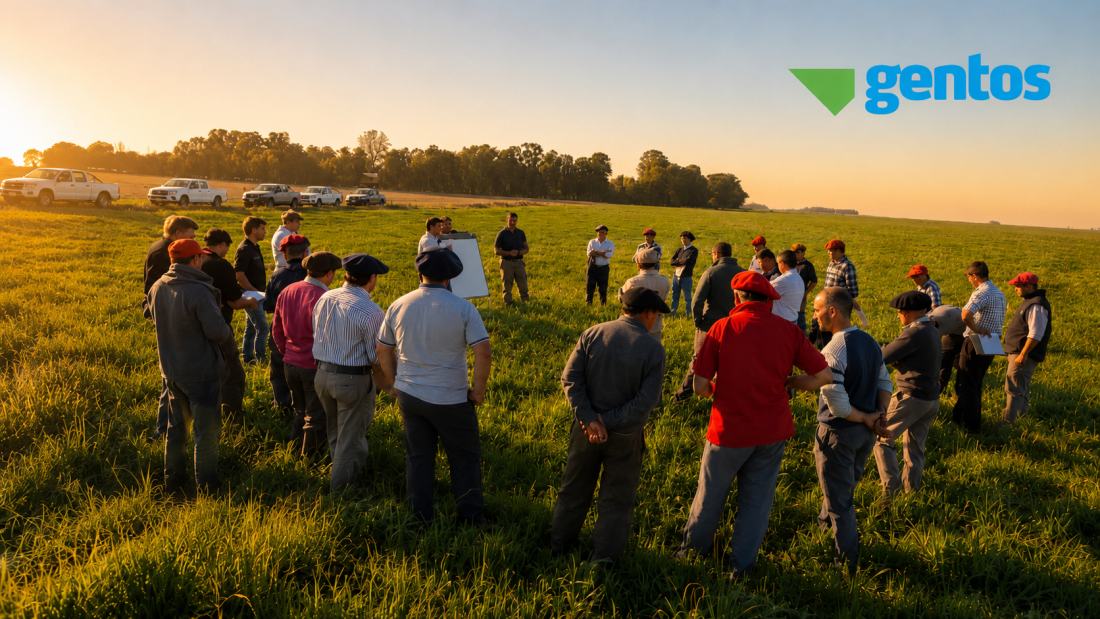
Its value proposition does not end with the sale of seeds. GENTOS works through model farms, field days, meetings with farmers, crop establishment monitoring, and technical recommendations designed to improve the performance and utilization of each pasture.
The seed is therefore integrated into a broader technological package, supported by management knowledge aimed at increasing meat or milk production per hectare.
Argentina: The Origin of Genetic Research and Development
Argentina is the birthplace of GENTOS and one of the main foundations of its regional structure.
From this market, the company conducts genetic improvement programs for grasses, legumes, and other species used in pasture-based production systems. Its experimental center in Pergamino plays a strategic role in material evaluation, genetic development, and the creation of solutions adapted to the productive environments of the region.
The Argentine operation also concentrates activities related to seed production, processing, commercialization, and exports. The company maintains strong relationships with livestock farmers, dairy operations, agronomists, technical advisers, and distributors.
The business is based on applied innovation: identifying production needs, developing new materials, evaluating them under real conditions, and transferring the resulting knowledge to farmers.
Argentina also generates the knowledge, experience, and genetic materials that support the growth of the Uruguayan and Brazilian operations.
An example of this regional integration was the visit of representatives from APASSUL, the Association of Seed and Seedling Producers of Rio Grande do Sul, to the GENTOS research center in Pergamino. During the visit, they learned about genetic improvement projects specifically developed for the Brazilian market.
Uruguay: Technical Proximity and Territorial Presence
In Uruguay, GENTOS has developed an operation closely connected to farmers and to the specific characteristics of the country’s livestock and dairy production systems.
The company has a team of agricultural professionals distributed across the territory, an extensive commercial network, and a technical service structure that supports clients from product selection through sowing, establishment, and pasture management.
Its portfolio includes grasses, legumes, sorghums, and other forage species, providing alternatives according to the environment, production system, and objectives of each farm.
The Uruguayan operation also has infrastructure for seed storage, classification, drying, and treatment. At its logistics center in Canelones, GENTOS operates a seed-coating facility where different technologies are incorporated to facilitate sowing and protect seeds against adverse environmental conditions.
In addition to its product portfolio, the company organizes field days, regional technical meetings, agricultural exhibitions, and training activities.
This vision also includes the Escuela de Pastores, or Grazing Managers School, a program designed for the people responsible for the daily management of grazing paddocks.
Its objective is to improve pasture utilization and contribute to producing more kilograms of meat or liters of milk per hectare, with lower costs and more sustainable resource management.
Brazil: Expansion Adapted to the Local Market
Brazil represents a strategic stage in the regional expansion of GENTOS.
The Brazilian operation builds on the knowledge accumulated by the company while developing a proposition adapted to the country’s production, commercial, and cultural conditions.
This includes the selection of materials suitable for different environments, the development of technical information in Brazilian Portuguese, and support from specialists in pasture management.
The initial GENTOS Brazil portfolio focuses on grasses and legumes supported by proprietary genetics, regional research, and a technical team committed to maximizing forage production and utilization.
The company seeks to build relationships with livestock and dairy farmers, distributors, agronomists, industry associations, and other influential stakeholders.
Within this process, Rio Grande do Sul is a particularly relevant territory due to its strong livestock tradition, its productive proximity to Uruguay and Argentina, and the compatibility of many of its pasture-based systems.
The challenge is not simply to introduce seeds into a new market. It involves building brand awareness, demonstrating the performance of the genetic materials, generating technical credibility, and establishing a commercial network capable of transferring GENTOS knowledge to different production regions throughout Brazil.
A Regional Platform with Local Adaptation
Although Argentina, Uruguay, and Brazil have different market and production characteristics, the GENTOS operation follows a common strategic logic.
Research and genetic development provide the shared regional platform. From this foundation, each country adapts the product portfolio, technical service, commercial channels, and communication strategy to its own production conditions.
Argentina contributes history, research capabilities, and scale.
Uruguay strengthens the model through technical proximity, territorial presence, and continuous farmer support.
Brazil expands the company’s regional dimension and opens access to a large-scale market that requires adaptation, positioning, and the progressive construction of trust.
This integration enables GENTOS to share genetics, knowledge, field experience, and commercial tools while preserving the identity and specific needs of each market.
AgenciaAgro as GENTOS’ External Marketing Department
To support this growth, AgenciaAgro works alongside GENTOS as an extension of its internal marketing structure.
The model goes beyond the traditional services of a communications agency. AgenciaAgro integrates with the company’s management, technical, and commercial teams to transform business objectives into strategies, campaigns, content, and actions that can be implemented in each market.
The work includes communication planning, the creation of technical and commercial content, the adaptation of materials between countries, digital channel management, advertising campaign support, and the development of actions related to events, field days, and farmer engagement.
In Uruguay, the strategy combines institutional positioning, product communication, coverage of technical activities, and support for initiatives with national reach.
This includes the conceptual and communication development of events that bring together farmers, technical professionals, distributors, business partners, and leaders from the pasture and livestock sectors.
In Brazil, AgenciaAgro develops communication specifically in Brazilian Portuguese, combining original content for the local market with the strategic adaptation of knowledge and experience generated in other countries.
This methodology makes it possible to maintain a consistent regional identity without transferring messages directly from one market to another without considering differences in language, production systems, seasonality, commercial channels, and business culture.
Communicating Knowledge to Create Value
In a highly technical industry, communication is not limited to presenting products.
It means explaining why a particular genetic material may be better adapted to a specific environment, how a pasture should be managed, which productive results it can generate, and what technical support stands behind each recommendation.
For this reason, one of the main objectives of the work between GENTOS and AgenciaAgro is to transform agronomic knowledge into clear, relevant, and useful content for each audience.
Communication must connect research with the field, technical teams with farmers, and the brand with the production decisions made on each farm.
A Strategy Connecting Genetics, People, and Markets
GENTOS represents an agribusiness model in which genetic innovation, technical service, and relationship building are part of the same value proposition.
Its growth across Argentina, Uruguay, and Brazil demonstrates that regional expansion does not depend solely on having strong products.
It also requires an understanding of each market, the development of local capabilities, continuous support for farmers, and consistent communication.
At AgenciaAgro, we support this process as GENTOS’ external marketing department, integrating strategy, agribusiness knowledge, communication, and regional execution.
Because behind a more productive pasture there is genetics, research, management, and collaborative work.
And behind a strong regional brand, there must be a strategy capable of connecting all that value with the market.
Sources: Official GENTOS websites and corporate channels in Argentina, Uruguay, and Brazil, together with institutional information provided by the company. Information reviewed in July 2026.