
Agribusiness · Business Strategy · Livestock
Communicating a Nation’s Quality
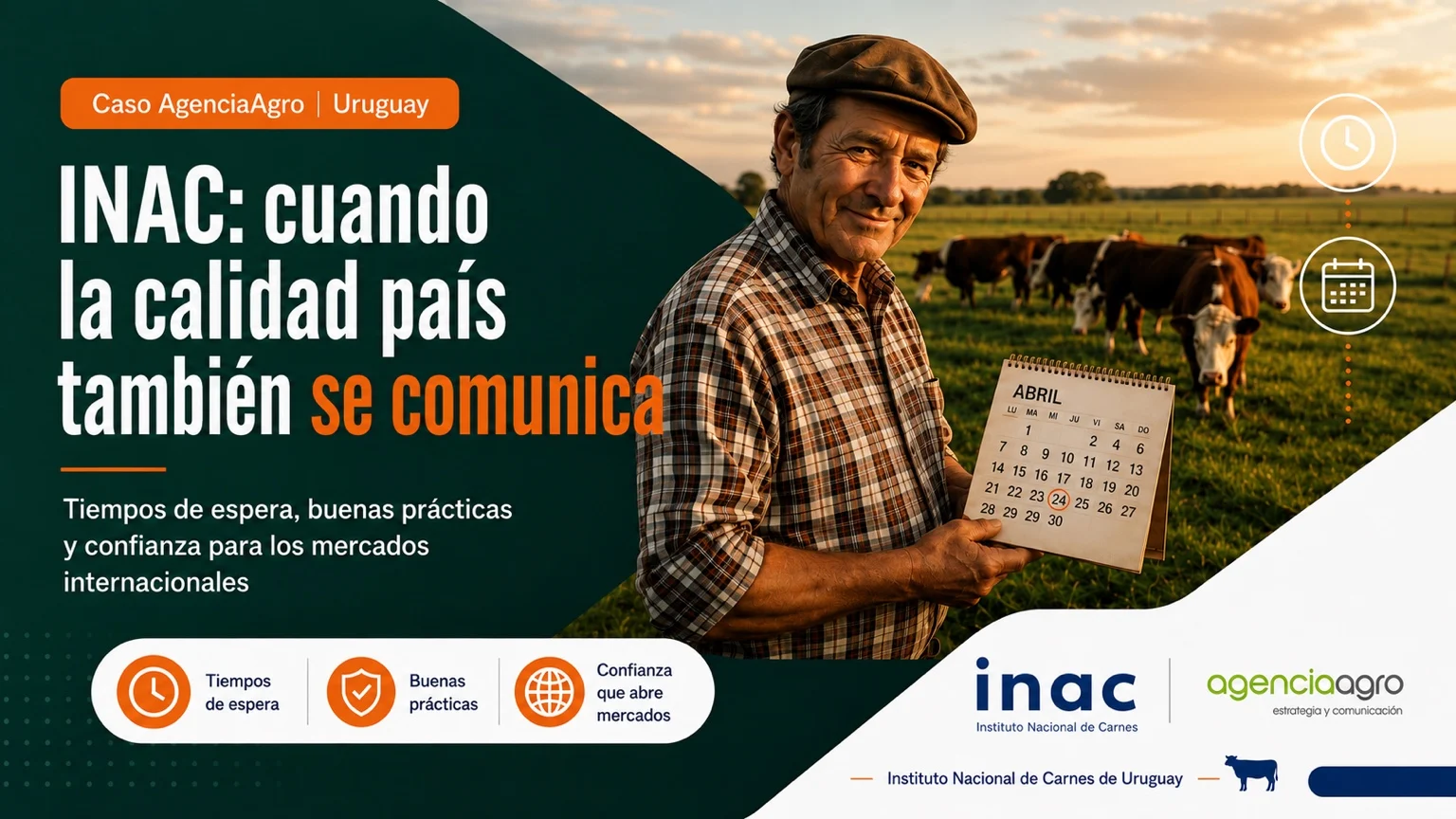
How a communication strategy can help align producers, veterinarians, industry, and public agencies around a standard that protects meat quality and the trust of international markets.
The quality of export meat begins long before slaughter
When a country builds an international reputation around food quality, that promise must be upheld at every link in the chain.
Uruguay is a good example. Its beef reaches some of the world’s most important and demanding markets. In 2025, Uruguayan beef exports generated USD 2.749 billion. USMCA was the leading destination by value, China accounted for approximately 29% of revenue, and the European Union consolidated its strategic relevance as a high-value market.
But reaching those markets does not depend solely on genetics, nutrition, traceability, management, or industrial technology. It also depends on thousands of decisions made every day on livestock farms.
One is especially important: observing the withdrawal period for veterinary medicines before sending an animal to slaughter.
The challenge: turning a technical requirement into a shared practice
INAC, together with Uruguay’s Ministry of Livestock, Agriculture and Fisheries, launched the campaign “Producing well also means knowing when to wait,” aimed at producers, veterinarians, and stakeholders in the meat supply chain.
AgenciaAgro worked with the National Meat Institute on developing and communicating this initiative, with the challenge of translating a technical animal-health topic into clear, memorable, actionable messages without losing rigor.
The concept is simple: every veterinary medicine has conditions of use and, when applicable, a minimum period that must elapse between the last administration and slaughter. This interval allows active ingredients and their metabolites to fall to levels compatible with the maximum residue limits established for food intended for human consumption.
That is why reading the label or package insert, recording every treatment, consulting a veterinarian, and confirming compliance with the withdrawal period before sending animals to a processing plant are part of a much broader quality system.
The campaign’s public website brings these recommendations together and explains the procedure in practical terms:
Communication that connects the farm to the market
The strength of initiatives like this lies in showing that a seemingly individual decision has a collective impact.
Failure to observe withdrawal periods can compromise food safety, lead to condemnations, trigger trade restrictions, and undermine the credibility of an entire supply chain. Conversely, when producers, veterinarians, public agencies, and processing plants share the same approach, the country strengthens its ability to uphold high standards and demonstrate consistency to international buyers.
MGAP also introduced visual labeling using orange octagons on veterinary medicine packaging to highlight the number of withdrawal days before slaughter. It is an example of communication at the point of decision: simplifying critical information and making it visible exactly when the producer needs it.
From good practice to national reputation
The connection to international markets is direct.
In March 2026, INAC brought chefs from the United States, Europe, and China to Uruguay—markets that together accounted for more than 80% of Uruguayan beef and offal exports in 2025—to strengthen the positioning of Uruguayan beef in global fine dining.
That figure captures the challenge: a country can invest in market access, international promotion, nation branding, business relationships, and premium positioning, but that work only holds if the entire chain operates under consistent standards.
The quality communicated externally must first be built internally.
That is why respecting withdrawal periods is more than a health requirement. It is also part of the value proposition of Uruguayan origin: traceability, responsibility, transparency, and the ability to meet the requirements of buyers in the world’s most important markets.
When regulation is not enough: driving adoption
This case offers a lesson for meat institutes, animal-health services, industry associations, agribusiness chambers, and export promotion agencies in other countries.
When a standard depends on the behavior of hundreds or thousands of producers, regulation is essential but insufficient. Information must be understood, remembered, and turned into an everyday practice.
That is where a well-designed industry communication strategy adds value.
An initiative of this kind can combine:
- a simple, repeatable creative concept;
- technical messages translated into operational language;
- materials for producers and veterinarians;
- digital content and targeted campaigns;
- reference landing pages;
- a presence at industry touchpoints;
- coordination between public and private organizations;
- visual systems that make decisions easier;
- enough continuity to establish habits.
The goal is not to “advertise.” It is to help an entire supply chain understand that the standard belongs to everyone.
An aligned supply chain protects value
For a producer, respecting the withdrawal period means correctly carrying out an animal-health practice. For a processing plant, it means reducing risk. For a public agency, it means protecting food safety and markets. For an international buyer, it means trust. And for an exporting country, it means reputation.
That is the point where communication stops being peripheral and becomes part of the quality strategy.
At AgenciaAgro we work precisely at that intersection of industry knowledge, strategy, creativity, technology, and execution. We help companies, multinationals, associations, and agribusiness institutions translate complex challenges into communication systems that drive understanding, alignment, and action.
Because when a product competes in the world’s most important markets, quality is not simply declared in an international campaign.
It is built into every decision. It is controlled. It is demonstrated. And it is communicated.
AgenciaAgro — Strategies that connect agribusiness with its market and the world.
Discover more at AgenciaAgro.com